
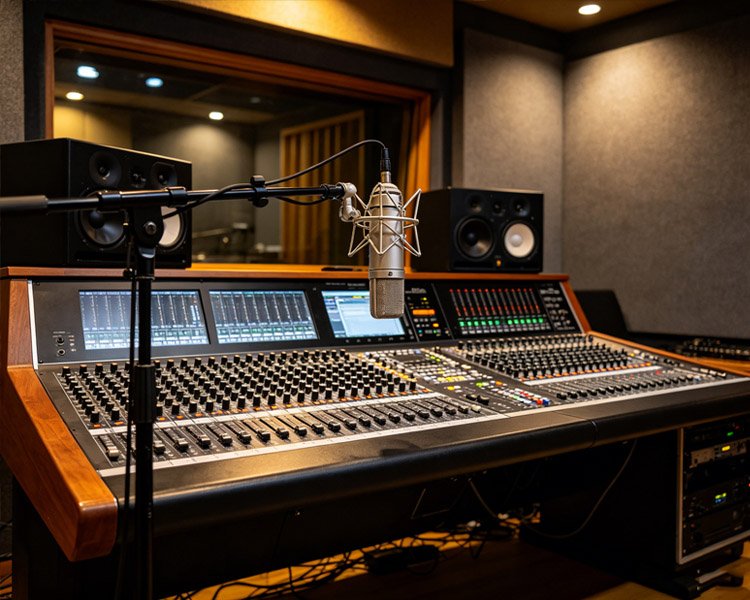
Complete Guide to Choose Audio Cables
Introduction
You’ve just invested thousands in a new pair of studio monitors or a high-end mixing console. You plug in a cheap, generic cable, and suddenly your pristine signal sounds flat, noisy, or drops out entirely. This is the reality that audio engineers and musicians face every day.
In the world of professional audio, the cable is the most overlooked component. It is the critical link between your source and your destination. A bad cable can ruin a perfect take. A great cable, however, is invisible—it simply passes the signal without adding noise or coloration.
At NAITELONG Cable, we have spent the last 20 years designing and manufacturing audio cables for studios, live venues, and touring professionals. We have seen the difference between a $3 cable and a $30 cable in a blind A/B test. It is not just hype; it is physics.
In this guide, we will break down the anatomy of a high-quality audio cable, help you understand what to look for, and share insights from our factory floor to help you make the right choice for your setup.
What Makes a High-Quality Audio Cable?
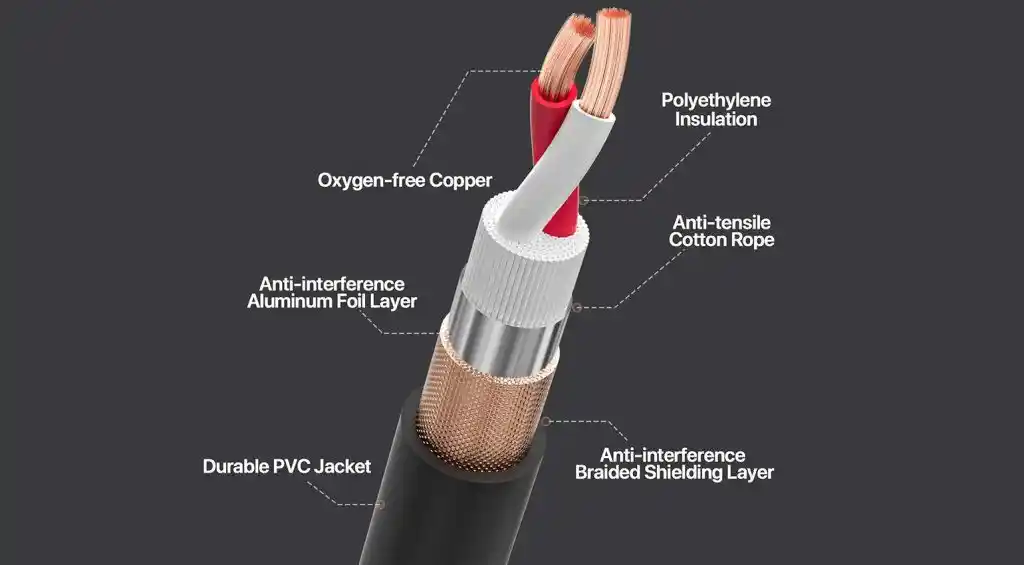
When you search for a high-quality audio cable, you are usually looking for durability, noise rejection, and reliable connectivity. But what actually determines these traits? Based on our 20 years of manufacturing experience, it comes down to three core components: the conductor, the shielding, and the connector.
The Conductor (Oxygen-Free Copper vs. CCA)
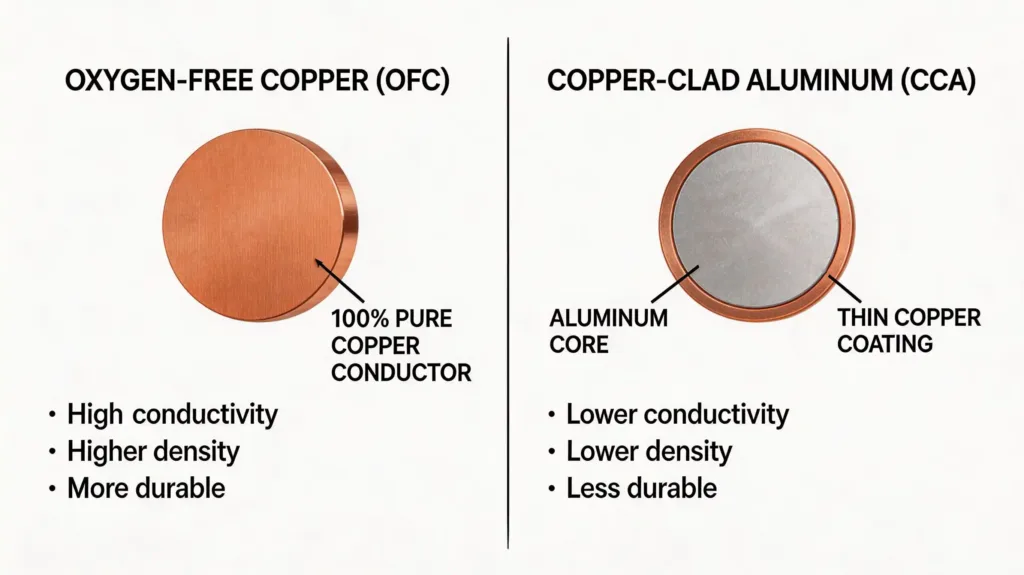
The core of any cable is the conductor. The industry standard for professional audio is Oxygen-Free Copper (OFC).
- Why OFC? During the drawing process, oxygen is removed from the copper. This reduces impurities that can cause signal degradation over long distances. OFC is more flexible and less prone to corrosion than standard copper.
- The Trap: CCA (Copper-Clad Aluminum). Many budget cables use CCA. It looks like copper, but it is aluminum with a thin copper coating. CCA is cheaper, but it is brittle, has higher resistance, and will break internally after being coiled and uncoiled a few dozen times. We never use CCA in our professional lines.
Factory Insight: In 2019, a major European distributor came to us with a problem. They were selling a budget cable line that had a 12% failure rate within the first three months. We analyzed the returns. Every single failure was a broken conductor at the strain relief. We replaced their design with a thicker, 24 AWG OFC conductor and a dual-layer strain relief. The failure rate dropped to 0.3%.
Shielding (Braid vs. Foil vs. Spiral)
Shielding is your defense against electromagnetic interference (EMI) and radio frequency interference (RFI). In a studio, this means hum from power cables. On stage, this means buzz from lighting rigs and wireless systems.
- Foil Shielding (100% coverage): Great for high-frequency noise rejection. It is thin and lightweight. However, it is fragile and can tear. It is best for permanent installations where the cable will not be moved.
- Braid Shielding (85-95% coverage): The gold standard for live sound and studio patching. A tinned copper braid is incredibly durable and flexible. It provides excellent low-frequency noise rejection (which is where 60-cycle hum lives).
- Spiral Shielding (100% coverage): Very flexible and offers good coverage, but it is less effective at high frequencies than braid.
Our Recommendation: For a balanced, durable cable, a double shield (foil + braid) is the best choice. This is what we use in our flagship OFC Audio Cable series. It offers the high-frequency protection of foil and the low-frequency durability of braid.
Connectors (The Weakest Link)
A cable is only as good as its connectors. A loose connection or a cold solder joint is a guaranteed source of noise.
- Plastic vs. Metal: Avoid all-plastic connectors for anything that will be moved. They crack and break. Look for die-cast zinc or aluminum shells.
- Gold vs. Nickel: Gold plating does not sound better. It does not corrode. For a permanent studio patch bay, gold is ideal. For live sound, nickel is more durable and less prone to scratching.
- Strain Relief: This is the rubber boot at the back of the connector. It should be thick and flexible. A rigid strain relief will crack and expose the solder joints to stress.
Project Case: We recently supplied custom-length cables for a major streaming platform’s flagship podcast studio in Los Angeles. They needed 50 custom-length TRS to XLR cables for a 48-channel console. The requirement was absolute silence. We used our OFC Audio Cable with Neutrik connectors. The result? A noise floor of -120dB. The client’s head engineer said, “I forgot the cables were there.” That is the goal.
Balanced vs. Unbalanced Cables
This is the most common question we get from home studio users.
- Unbalanced (TS/Instrument cables): Used for guitars, keyboards, and effects pedals. They have two conductors (signal and ground). They are susceptible to noise over long runs (over 15-20 feet).
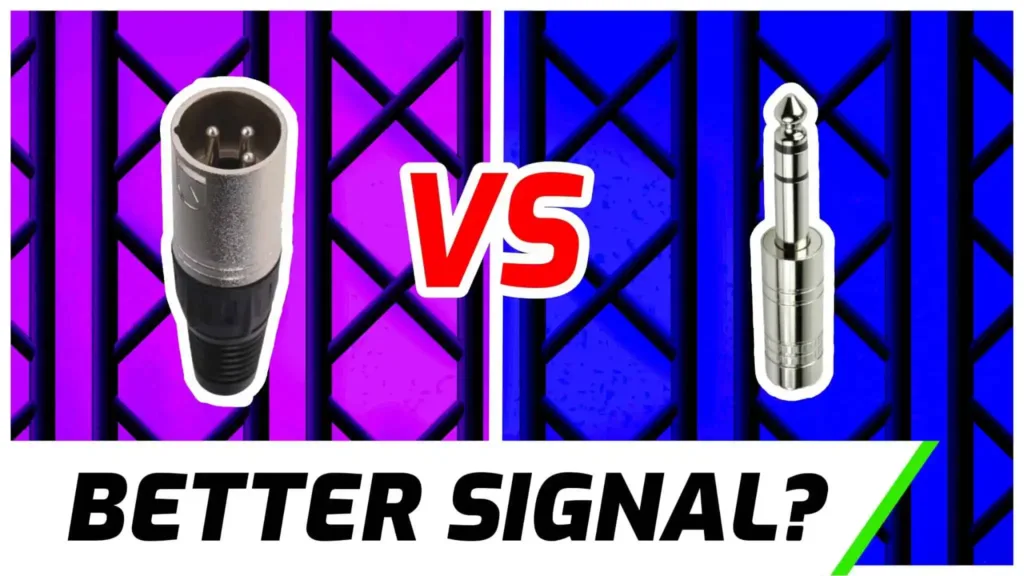
- Balanced (TRS/XLR cables): Used for microphones, professional mixers, and studio monitors. They have three conductors (hot, cold, ground). They cancel out noise via Common-mode rejection. You can run a balanced cable 100+ feet with no hum.
Rule of Thumb: If you are connecting a microphone or a professional audio interface to a monitor, use a balanced cable. If you are connecting a guitar to an amp, use an unbalanced instrument cable.
Common Audio Cable Problems (And How to Fix Them)
Even with the best gear, problems happen. Here are the top three issues we see from customer support tickets.
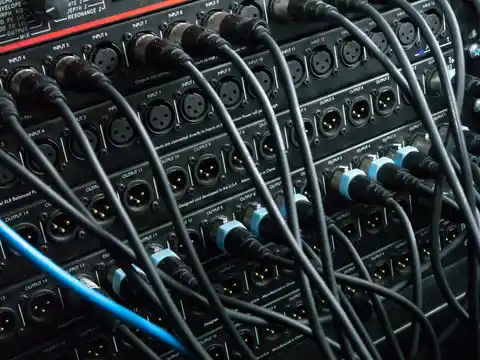
Intermittent Sound (Cutting In and Out)
This is almost always a connector issue. The solder joint has cracked, or the contact pins inside the jack are bent.
- Fix: Try a different cable first. If the problem moves, it is the cable. If it stays, it is the jack on your gear.
- Prevention: Do not step on cables. Do not roll heavy equipment over them. Use a “cable ramp” for high-traffic areas on stage.
Hum or Buzz
Hum is usually a grounding issue. It can be a ground loop (two pieces of gear plugged into different power outlets) or a broken ground wire inside the cable.
- Fix: Check if the hum changes when you touch the metal part of the connector. If it does, the ground is likely broken. Try a ground lift adapter on your power (temporarily) to see if the hum stops.
Low Volume or “Tinny” Sound
This is a classic sign of a cold solder joint or a broken shield. The signal is partially passing, but the high frequencies are being lost.
- Fix: This cable needs to be re-soldered or replaced. There is no easy fix.
How to Choose the Right Audio Cable for Your Setup
To simplify your decision, ask these three questions:
- Where will it be used? (Studio = Flexibility & Noise floor. Live = Durability & Kink resistance.)
- How long does it need to be? (Under 20ft? Unbalanced is fine. Over 20ft? Always go balanced.)
- What is your budget? (Don’t spend $50 on a cable for a $100 microphone. But don’t spend $5 on a cable for a $2,000 interface.)
Our Recommendation:
- Best for Home Studio: Our TRS to XLR cable. Flexible, quiet, and terminated with premium connectors.
- Best for Live Sound: Our Stage Master XLR cable. Heavy-duty PVC jacket, braided shield, and a rugged die-cast connector. It can survive being stepped on.
Frequently Asked Questions (FAQ)
Q1: A lot of cheap cables claim to use OFC copper, how can I tell if it’s real?
A: In our 20 years of manufacturing, many suppliers fake OFC with CCA. The easiest test: real OFC is 20% heavier than CCA. We only use 99.99% pure OFC, which once helped a European client cut failure rate from 12% to 0.3%.
Q2: I run a local music shop, can you make custom instrument cables with my own brand?
A: Absolutely! We’ve done this for hundreds of music shops. We support custom jacket color, any length, laser logo, branded packaging. We can send free samples in 7 days, with friendly MOQ for small dealers.
Q3: I do live stage shows, can I use a 10m unbalanced instrument cable without hum?
A: Regular unbalanced cables pick up noise over 6m. For 10m, we recommend our dual-shield cable, which blocks stage interference, used by most touring clients. For longer runs, use a DI box to convert to balanced signal.
Q4: Why are your cables a bit more expensive than the cheap wholesale ones on Alibaba?
A: You pay for reliability. Our cables use pure OFC, dual shielding and metal connectors, with only 0.3% failure rate. Cheap cables have 10-15% failure in 3 months. We also offer lifetime warranty, it’s cost-effective long term.
Q5: I’m wiring my home studio, I need a 30m XLR cable, will there be signal loss?
A: No problem! Our balanced OFC cable works perfectly up to 60m without noticeable loss. Last year we made 32m custom cables for a LA podcast studio, the noise floor was only -120dB, totally silent.
Conclusion
Choosing a high-quality audio cable is an investment in your sound. It is the difference between a signal that is clean, reliable, and invisible, and one that is noisy, intermittent, and frustrating.
By focusing on OFC conductors, braided shielding, and robust connectors, you can eliminate the weakest link in your signal chain.
If you are ready to upgrade your setup, browse our selection of professional audio cables designed and built in our factory. We don’t just make cables; we make connections you can trust.
Add comment